The Write Stuff
Can you believe what you read?

This past week I’ve been knocked down by a terrible cold. Yes, I’m sure it’s not COVID. I was tested twice - once being the PCR or Polymerase Chain Reaction test, where the specimen is sent to a lab for analysis and takes a couple days for results to come back; the second being the antigen test where the result is known in 15 minutes - and both came back negative. The results provided little relief because the list of symptoms have continued to plague me, though have finally started to subside. My cough, sinus congestion, and bags under my eyes, among others, had the Powers-That-Be at work in quite a stir, but since I am not on my deathbed with the Wuhan Flu, the feckless bureaucrats have unpuckered themselves enough to get back to their slide-rules and shoelace-counting.
The reason for their “concern” arose from their own creation. After reporting my symptoms to my supervisor, he — as any good supervisor would do — double-checked with the section head on how best to handle my time off (since there has been no attempt in the past nine months to write any kind of mitigation plan or policy regarding this new plague that has befallen us). The response was that if I decided to stay home while awaiting my PCR results and the results came back negative, I would be charged leave time, but if they came back positive, then it would be paid time off during the quarantine period. This, seeming like an asinine response, initiated my passive-aggressive side, prompting me to go to work the next day, despite feeling like I had been hit by a train. My coworkers - and even the HR rep I contacted regarding this ridiculous mandate - all agreed with me that this was not the way to run an organization when this disease is threatening to end all life on the planet (insert eye roll here). Tangent: Don’t get me wrong. I know it is a threat to high-risk populations and caution should be taken, but with better than a 98% US survival rate among all demographics, the political grandstanding and power-grabbing that has taken place has proven to be more harmful to families by way of economic and psychological hardships.
The following day, I returned to work, not having improved much, but still capable of performing my job duties. Apparently, word had made it to someone on “King’s Row”(where all the supervisors’ supervisors sit) that I had recently lost the abilities to taste and smell. I was immediately sent home, while my supervisor received a butt-chewing exactly how inept military officers scold a senior NCO for following unlawful orders given forth by the same mush-brain who handed them down. My favorite line from the PhD in charge of our unit who had promulgated the idotic edict: “I know my email said this but I meant that...” Mind-reading has yet to be perfected at our workplace. Fortunately, our agency is better at building roads than sentences (but only barely).
Anyway, this extra time off has allowed me some not-needed additional couch time. I decided to spend an entire morning and half an afternoon watching the first (and thus far only) season of The Right Stuff on Disney +. It had been many years since seeing the movie of the same name from the early ‘80s so this eight-episode season offered not only a refresher on the beginnings of the US/Soviet Space Race, but a deeper look than can be shown in a single movie.
I was unaware of the competitiveness between John Glenn and Alan Shepard, but it has been well-documented, as I found when I researched the bitter rivalry between the two. There were two camps among the “Mercury 7” (the label given to those seven test pilots chosen from many scores of applicants who were to be part of NASA’s Mercury program, which predated the Gemini and Apollo programs: initiatives to get an American into space, then to the moon as quickly as possible). One was of the persuasion that they were not perfect, so should not be presented as such, their lives were their own, and basis for selection into the program and who should be the first into space should be determined by their abilities, not their characters. The other, smaller camp, believed that the ideals and goals of the Mercury program and nation should be reflected in their characters, that they were to maintain a higher standard as someone to whom little boys could aspire to be one day: representatives of God, country, mother, and apple pie. One group consisted of arrogant, heavy drinking womanizers. The others were faithful husbands and mindful of their actions. Fighter jocks versus Boy Scouts.
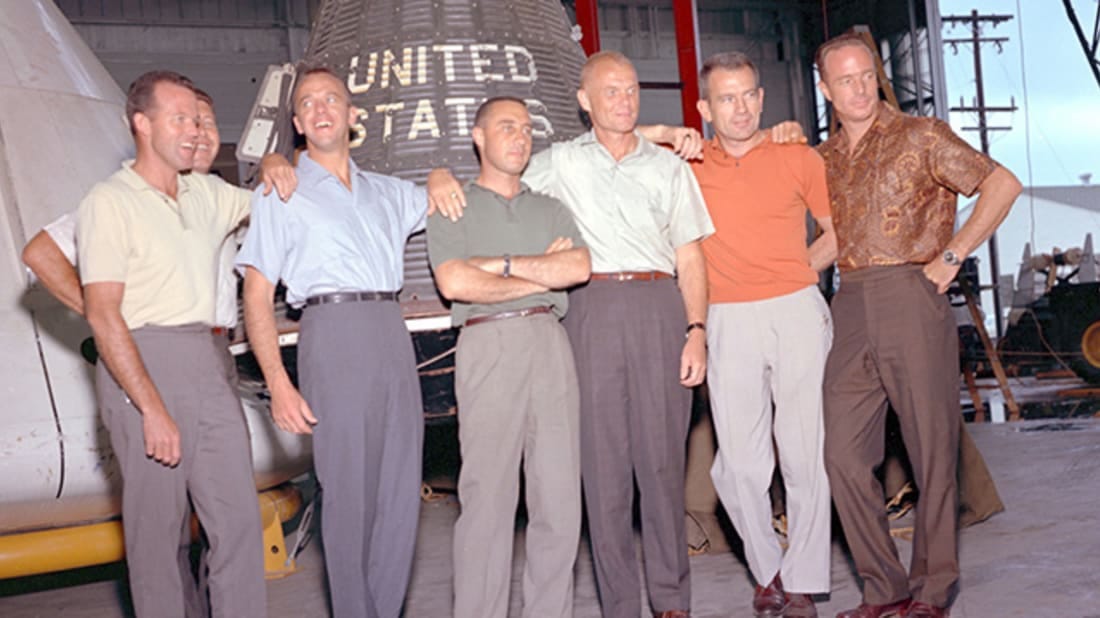
LIFE magazine bought exclusive access to the “7’s” families, as well as their personal lives from 1959 to 1963. The clean-cut, wholesome, All-American boy image was sold to the public, despite the partying and philandering that actually happened under the shroud of darkness. Apparently, some of the wives knew what was happening, but chose to look the other way - for a myriad of reasons: divorce was socially taboo, being married to a successful aviator and astronaut was too enticing, fear of loss of social status, and a host of other personal motives.
So who is right? Considering the context of the late ‘50’s and early ‘60’s, the image put forth by LIFE magazine was consistent with the culture of the time. That wholesome kid-next-door image was everywhere. Sure, there were the “James Dean” types, and girls who had “bad” reputations, but for the most part, there were “…flat tops, sock hops, Studebakers, Pepsi please… oh, do you remember these?”
While this classic Statler Brothers song manifests a longing for the “good old days,” the vacuum it creates is one filled with nostalgia, romanticizing, and viewing history through rose-colored glasses.
Those who were expected to live up to society’s standards often found themselves falling short. Drugs, alcohol, and extra-marital affairs were easily-accessible escape hatches, which led many down rabbit holes that were and are rarely talked about: clinging to the past, harsh realities, and not being good enough.
The Crosby Boys were a good example. The first four sons of famed Bing Crosby - Gary, Dennis, Phillip, and Lindsay - were all born in the 1930’s when dad was beginning to crest the wave of popularity that would carry him all the way to his grave in 1977. Imagine, having a dad who was billed by LIFE magazine in 1945 as “America’s number one star…[who] has won more fans, made more money than any entertainer in history.” How do you compete with dad and his pals, Frank Sinatra, Bob Hope, Dean Martin, Perry Como, and a choir of others: first-rate performers who captured the hearts of millions of people? What else do you do but start a quartet?
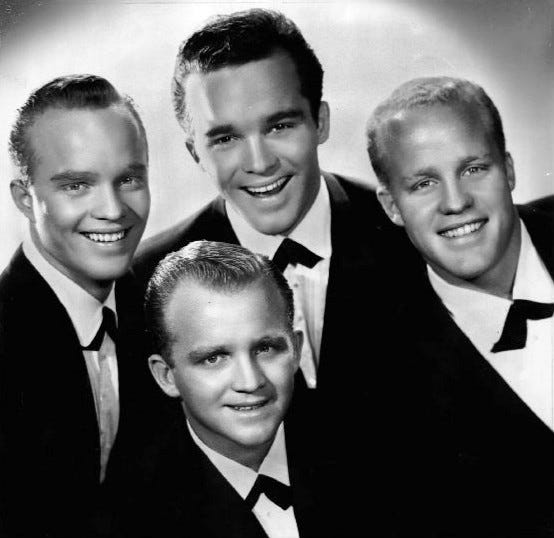
Talk about clean-cut. Look at them... But Gary only lasted a couple years, then embarked on an acting career. He went on to write a revealing and highly critical memoir about his childhood, dad’s emotional and physical abuse, and the injurious effect of growing up with an alcoholic mother. He died of cancer at the age of 62.
Lindsay had a nervous breakdown, which ended the brothers’ singing group career. He turned to alcohol and committed suicide in 1989 at the age of 51.
Dennis suffered from mental health issues also, was divorced, and took his own life two years after Lindsay, dying at 56.
Phillip lived the longest of the four, dying at the age of 69 from a heart attack. He, too, struggled with alcohol and had been married four times.
These boys grew up in recording studios, rubbing elbows with the century’s greatest performers, and never wanting for anything: big houses, swimming pools, and parties. But those “lucky” boys grew up, and as empty men, they wrestled with self-esteem issues, depression, and profound feelings of inadequacy. What kind of love and leadership did Bing provide these lost boys?
Why state all this? I have thought deeply about this topic over the past several days. I am hesitant to even write such things about immense icons like “America’s First Spacemen” and “Father O’Malley.” I don’t use them as examples in order to sully their names among my microscopic audience. When I was a teenager, I dreamed about racing around the skies like Chuck Yeager and Tom Cruise as “Maverick.” Holiday Inn (1942) and White Christmas (1954) are two of my top three all-time favorite Christmas movies. But it’s important to not lose perspective of what’s real among what’s written or seen.
“Image” is what is presented to the public. “Character” is what you have when no one is watching. Can a secular culture build a solid foundation of morals, virtue, and wholesomeness? Certainly not. So can you believe what you read?
The Bible reveals men who tried and tried to do the right thing and failed continuously. Moses killed a man and hid in the desert for 40 years, King David slept with his general’s wife, got her pregnant, then had the general killed so he wouldn’t find out. Saul of Tarsus - before becoming Paul the Apostle - hunted down and persecuted Christians, supposedly overseeing the stoning of Stephen, the first martyr of Christendom. So even these great men of the Bible aren’t “good enough.”
The only one who was, is, and ever will be is Christ. He came to earth under the weight of flesh in order to save sinners. His own words from John 12:44-50:
And Jesus cried out and said, “Whoever believes in me, believes… in Him who sent me. And whoever sees me, sees Him who sent me. I have come into the world as light, so that whoever believes in me may not remain in darkness. If anyone hears my words and does not keep them, I do not judge him; for I did not come to judge the world but to save the world. The one who rejects me and does not receive my words has a judge… For I have not spoken on my own authority, but the Father who sent me has Himself given me a commandment--what to say and what to speak. And I know that His commandment is eternal life. What I say, therefore, I say as the Father has told me.”
Man, born of a virgin, infallible, sinless, came to bear all the sin of mankind so that we - US - even 2000 years later, can be forgiven and set aside for eternity with Him. His perfect earthly life began in that lowly, dark manger. His perfect earthly life ended on that wretched, rugged cross. We know this because that is what is written. Those words we can believe. There is no “image” He is trying to create. No façade that shows one person, but behind closed doors, someone else. He is calling all of us, just as He called Moses to lead the Jews from Egypt after his self-imposed exile; He called David to have another son - Solomon - who became the wisest and wealthiest man the world has ever seen after the affair with Bathsheba and the murder of Uriah; Saul was converted to Paul on the road to Damascus after he persecuted Christians.
You see, none of us are good enough. If the aforementioned men aren’t perfect, then none of us are worthy of His grace. In man’s world, despair is what awaits us when we fight with those self-defeating feelings. But in God’s world, we can be redeemed through His blood, which can only be shed after His birth. That is the legacy of Christmas. Sure, it’s a great story that children love reenacting, dressing up as camels, wise men, and angels, but it’s actually the beginning to The Greatest Story Ever Told.
And the wonderful news is, we don’t have to pretend to be one thing in public, then someone else privately. We can transparently be who we were designed to be by God. Fallible, sinful, weak, insufficient. It’s okay with Him. We can even be a little salty and punchy from a nasty cold. Just remember to say a prayer for those knuckleheads who give you reason to gripe. Then say one for yourself.
If I don’t get another one of these out beforehand, have a wonderful Christmas. Be sure to sing a lovely verse of “Silent Night,” including the consonants. ;)